_e.png)


Why Stronger Pressure Is NOT Better In Facial Massage
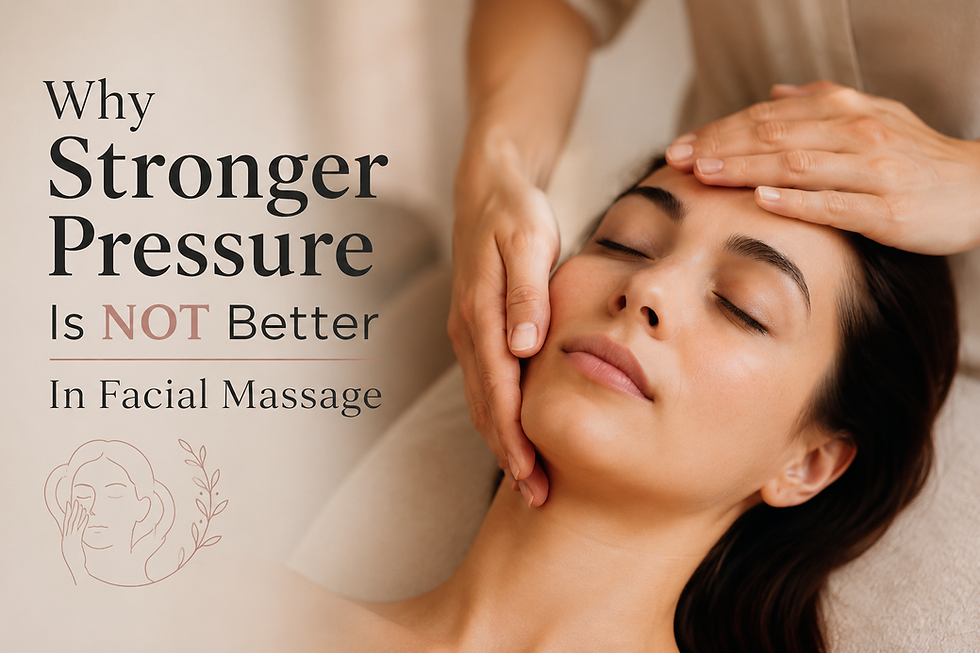
When people book their first facial massage, many expect one thing:
"The deeper the pressure, the better the results."
It's a common belief. We often associate strong pressure with effectiveness because that's how many body massages work.
But the face is different.
A professional facial massage isn't about using as much force as possible. In fact, too much pressure can work against what you're trying to achieve.
Your face isn't built like your back
The muscles in your face are much smaller and much more delicate than the muscles in your shoulders or legs.
They're closely connected to the skin, facial expressions and the lymphatic system. This means they don't need aggressive pressure to respond.
The goal isn't to "dig into" the muscles—it's to communicate with them.
Gentle, precise techniques are often far more effective than force.
More pressure doesn't mean better results
Many people believe that if a massage hurts, it must be doing something good.
That's not always true.
Excessive pressure can:
irritate sensitive tissues
leave the skin feeling sore
create unnecessary inflammation
make the muscles tighten up even more as a protective response
Instead of encouraging relaxation, the body may actually become more defensive.
The secret is consistency, not intensity
Think about stretching.
You don't become more flexible by forcing yourself into the deepest stretch possible. You improve by working gently and consistently.
Facial massage works in a similar way.
Regular treatments help improve circulation, encourage lymphatic drainage and gradually reduce facial muscle tension. Over time, this can leave your face looking brighter, softer and more refreshed.
Natural results come from repetition—not from aggressive techniques.
Why Kobido feels different
Traditional Kobido facial massage combines a variety of techniques and rhythms throughout the treatment.
Some movements are energising, while others are incredibly slow and calming.
The purpose isn't simply to massage the skin. It's to release unnecessary tension, stimulate healthy circulation and support the face's natural function.
A skilled therapist constantly adjusts the pressure depending on the area being treated.
The delicate skin around the eyes, for example, requires a completely different approach than the jaw muscles.
Every face needs something different
One of the biggest misconceptions is that everyone should receive exactly the same treatment.
In reality, every face tells a different story.
Some people hold most of their tension in the jaw from clenching or grinding their teeth.
Others carry it in the forehead from concentrating at a computer all day.
Some simply need deep relaxation rather than stimulation.
That's why every facial massage at The Kobido Room is personalised. I adapt the techniques, rhythm and pressure to your facial muscles and your individual needs—not to a fixed routine.
The best facial massage should never feel like a battle
After a treatment, your face should feel lighter, relaxed and refreshed—not bruised or overworked.
The most effective facial massage isn't about how hard someone presses.
It's about understanding the anatomy of the face, respecting the tissues and using the right technique at the right moment.
Sometimes, the gentlest touch creates the biggest difference.
If you're looking for a natural way to release facial tension, support healthy skin and enjoy deep relaxation, a personalised Kobido-inspired facial massage may be exactly what your face has been asking for.
I'd love to welcome you to The Kobido Room and help you experience the difference for yourself.


Comments